Jul 7, 2016
by: Melinda Cohan, Jul 7th, 2016
Note: This is the first article in a 5-part series designed to guide you in aligning your business mindset, actions, and goals, and therefore supercharging your productivity and success. (episode 2, episode 3, episode 4, episode 5)
Do you remember the first time someone referred to you as an entrepreneur?
I’ll never forget the first time someone called me that. It was like a badge of honor—one I didn’t deserve.
I didn’t consider myself an entrepreneur; I was a coach. I thought: An entrepreneur is someone who takes big risks, does their own thing and is SUPER smart and savvy. I don’t know anything about business! I’m not business savvy. Sure, I’m a good manager and great at the work I do, but to own my own business? No way!
After all, at that point in my life, I had been fired from my job and had decided to turn what was then a fun hobby—coaching—into something that could support me financially. And that was exactly how I thought of it: coaching was something I was really good at and loved doing; I consider it my higher purpose, even – and I also got paid for it. (Which of course, is just awesome, right?)
The thing is, I was a “technician” (or as some would call it, a “practitioner”), getting paid to do something I was good at – and something I loved.
That’s a FAR cry from being an entrepreneur.
For me, the technician mindset was all well and good, until someone else saw me as an entrepreneur… and that was the spark that allowed me to begin to see myself as one, as well. That’s when things really changed for me. In fact, that’s when I was able to achieve rapid growth and success with my coaching.
What does this mean for you?
If you’re in the “I’m a coach,” mindset, you may set goals and intentions as a business owner, but you still take action as a coach – as a technician.
Therefore, you don’t grow your business as effectively as you could.
If you can get into the business owner mindset, your actions will align with it, and you’ll supercharge your productivity and success.
That said, let’s talk now about the evolution of the entrepreneur.
Imagine, for a moment, a ladder.
The Evolution of the Entrepreneur starts at the Technician Rung.
The next rungs are Hobbyist, Business Owner, CEO, and Shareholder.
I want to ask you to take a moment right now to decide which of those rungs you are currently on, in your business.
Don’t think about your answer too long—just throw it out there.
Now, I’d like to invite you to answer a few questions to help you determine which rung you’re really on. 🙂
Then, in my next article, I’ll outline the specific characteristics of each rung, and how to move from one to the next, so you can run your business AND live your life with the success and freedom for which you work so hard.
The Quiz:
- When someone asks you “what do you do?” how do you respond?
- “I’m a coach”
- “I help people” (or some extended variation of this)
- “I own my own business where I coach people”
- “Through my products and services I help people accomplish XYZ”
- “I’m invested in businesses”
- When it comes to being an entrepreneur, what are your biggest fears?
- “Will I have to get a j-o-b so I can make enough money?”
- “Will I hire the right people?”
- “Will I be able to scale my business and leverage my full team?”
- “Can my team members and Directors really do as well as me, and take care of this business as if it were their own?”
- “Will this bring me my expected return on investment?”
- When it comes to being an entrepreneur, what are your greatest desires?
- getting paid to do something I love
- helping clients, making money, and having a big impact
- working smarter, not harder
- leveraging a team to scale the business so it runs without me
- creating consistent passive income
- When it comes to marketing, which is the most accurate?
- You get furious when someone tells you to pick a niche.
- You dabble in different approaches, rather than having a consistent strategy for bringing in a steady stream of clients.
- Your marketing is effective and you see a steady stream of clients and cash flow as a result of your efforts.
- You have multiple marketing strategies in place, and they’re all generating steady streams of clients.
- You’re researching vertical markets you can serve.
The Analysis:
If your answers are mostly A’s: you’re operating from the mindset of a Technician.
If your answers are mostly B’s: you’re operating from the mindset of a Hobbyist.
If your answers are mostly C’s: you’re operating from the mindset of a Business Owner.
If your answers are mostly D’s: you’re in the mindset of a CEO.
If your answers are mostly E’s: you’re in the mindset of a Shareholder (if this is you, congratulations!).
Why congratulations?
You’ll have to wait for next week’s article … 😉
Stay tuned to your inbox for Part 2 of this article series, in which I outline the characteristics of each Rung, and provide you with specific steps for moving right on UP the ladder … from Technician to Shareholder.
Jun 16, 2016
What is the #1 motivator for most people who strive for and even achieve success?
It may surprise you…
I’ve met and coached a lot of people over the years in my journey to success and abundance and I’ve come learn that there is true success, and then there is something that I call ‘apparent’ success. And the one thing that differentiates the truly successful from the ‘apparently’ successful, is their underlying motivation.
There are lots of people who are striving and working hard to support their families, to advance in their careers, to climb the corporate ladder, or to run their own businesses who are NOT doing it because they really LIKE what they do, but because they place a high value on SECURITY. Because they want to provide for their themselves, their families, their future, and they are afraid of what might go wrong if they don’t work really hard.
Often they sacrifice their time, their health, and even relationships with the very family they are seeking to provide for, in order to create a freedom that will arrive ‘someday’. That ‘someday’ is always in the future, dangling in front of them like a carrot that is always out of reach… it’s not here and it’s not now. In the here and now, they have trouble enjoying their lives, because they are always hustling, always chasing, always stressed out, and living for that ‘someday’ when they can slow down and really enjoy their lives.
When you dig into this, what they are motivated by is FEAR.
Fear can be very motivating! And in a lot of ways that can have its usefulness. You can get a LOT done in the fear mode. You can qualifications in fear mode. You can get a job in fear mode. You can get a mortgage in fear mode. You can even get ‘apparent’ success in fear mode.
And it’s not surprising that so many of us are living in this state of fear. We may not even realize we are in it…
Every single day we are bombarded with messages designed to stoke our fears about security, scarcity, wars and conflict that increase our sense that there is ‘not enough’…we are bombarded with messages that we need to be better, smarter, more educated, fitter, thinner, whatever, in order to be OK (because somehow we are also ‘not enough’)… and then we are encouraged to appease and cover over our resulting anxiety and insecurities with material ‘stuff’… by buying something, eating something, drinking something, or distracting ourselves with TV, video games, social media etc.
It’s a vicious cycle of fear, followed by destructive and unhealthy numbing of that fear, followed by anxiety, health problems, and even depression.
The thing is, there’s a REALLY high price to having the ‘fear’ switch in our brains stuck in the ‘on’ position all the time. It keeps our adrenal glands pumping non-stop and leads to all kinds of stress-related conditions like muscle tension, headaches, and even excessive weight gain especially around the abdomen.
It can also lead to poor ‘knee-jerk reaction’ type decision making, leading to situations where even though we are crazy busy, we’re just spinning our wheels and not making much progress towards our dreams.
So fear is really one of those things that’s most useful in ‘fight or flight’ type crisis situations – when it can really save our butts – but not so great as a constant motivator in our lives.
It can be tough to break out of the fear mode once we’re in it, though, because it can be self-perpetuating.
If you’re feeling stuck in such a vicious cycle, trust me you’re not alone.
When we are stuck in this fear and consumption mode 24/7, it makes it hard for us to enjoy life’s simple pleasures. It really can hamper our ability to feel simple joy, happiness and peace in our lives.
It begs the question: Is there a better way?
What is real success and abundance, free from fear? What does it look like in practice? How do we choose it? And how can we all collectively change our mindset and choose a better way for the future of our planet?
Well, three years ago some friends of mine decided to start a journey to answer these questions. They wanted to challenge fear-based thinking and to foster a belief that true joy, abundance and happiness is available to everyone. They interviewed 17 different thought leaders from around the world and asked them how people can make the shift from fear to joy, from scarcity to abundance… and they made a film about what they found out, called The Abundance Code.
Click here to watch the full 90 minute film for FREE
This film is so inspiring, that I want to share it with you…
There are so many amazing people in the film!
- NY Times Best-selling Authors like John Assaraf, Jeff Walker, Roger Hamilton and Bill O’Hanlon.
- Mindset and Psychology Experts like Dr John Demartini, Dr Sherry Buffington, Dr Ruth Buczynski, Tim & Kris Hallbom, and Julie Ann Cairns.
- Motivation and Happiness Experts like Dr Robert Holden, JB Glossinger PhD, and Satyen Raja.
- Visionaries and Entrepreneurs like Sonia Simone, Victoria Labalme and Jon Gabriel.
If you’re like me, and you’re always looking for ways to enhance and create a life of fulfillment, joy and abundance… then you simply HAVE to check this out.
The Abundance Code film is launching 21st June, 2016. And for a limited window of 10 days you can watch it for FREE. The 3 minute trailer for this film has just been released and you can watch it NOW, and see for yourself why I’m so excited to be part of it.
Click here to watch The Abundance Code 3 minute trailer
This amazing and eye-opening film is launching to the world on June 21st with a 10 Day FREE Worldwide Online Premiere Screening. You will want to see it!
Click here to Sign up for the FREE Online Premiere
P.S. Go ahead and forward this email to anyone who you believe will benefit from it too…
Apr 19, 2016
When someone—a potential client or referral partner—asks you what you do, are you selling the boat?
We know … right now, you may be thinking, “I’m a coach. I’m not in boat sales. What the heck are you talking about, Melinda?”
Stick with us, here.
You may remember our Pain Island/Pleasure Island diagram, which shows your ideal client’s Pain Island—his or her top 3 challenges, and his or her Pleasure Island—the top 3 desired results.
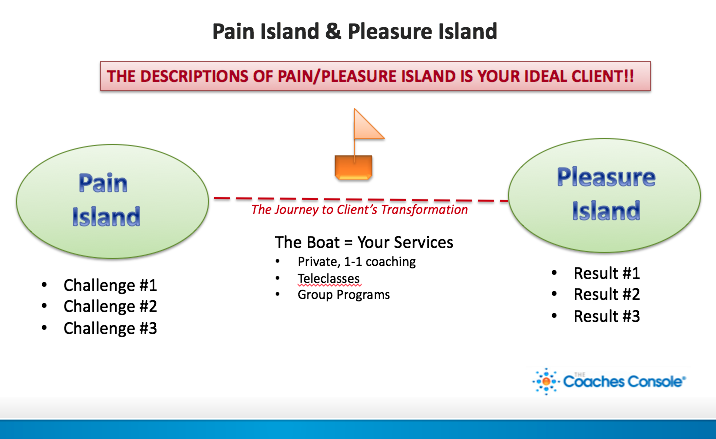
Your boat—the packages, programs, and services you provide—is what gets your ideal clients from their Pain Island to their Pleasure Island.
So here’s the thing:
If you’re at an event or on a call, and someone asks you what you do, you may be making a big mistake with your answer.
That is, you may be explaining your packages, programs, and services (the boat), rather than showcasing the transformation you provide.
So why is that a mistake?
They buy a transformation.
And that’s exactly why we’re writing this today: we want you to stop selling the boat!
When you’re asked “What do you do?”
DON’T (for the love of Pete, DON’T) say: “I’m a coach and I offer several different packages.”
DO: Sell the journey.
Sell the transformation you provide. Sell the trip from Pain Island to Pleasure Island.
That way, you’re inviting people to step into your boat, by focusing on the results your clients will experience when they do.
This goes back to what we talked about with regard to your niche in a previous blog post: that is, you must identify the group of people you’re passionate about helping, and then identify the challenge they most want to overcome.
Then, you present yourself as the solution.
Here are some examples:
- A tennis coach who works with tennis players who want to serve better and win games might say, “I help tennis players improve their serves so they can stop losing games.”
- A specialty dog trainer might say, “I help dog owners train their dogs effectively so they can live in harmony with their furry friends.”
- Here at TCC, we say, “We help start-up coaches systemize their businesses so they can get more clients and make more money.”
Bonus Tip:
Don’t guess!
Great marketing, great enrollment conversations never come from guessing.
It’s important to remember to interview your ideal prospects (or people like them) to uncover the specific words and phrases they use to describe their challenges and the results for which they’re striving, and use those same words or phrases when you sell the journey. If you’re guessing, you won’t get conversions. So, don’t guess. Ask.
As always, we’ll leave you with a few action steps you can take to practice selling the journey rather than the boat.
Action Steps
- Identify your ideal client.
- Narrow in on 3 specific Pain Island points—3 specific challenges your ideal client is facing and wants to solve … in their own words!
- Identify the top 3 Pleasure Island points: that is, specific results your ideal client would like to achieve or experience… in their own words! (Are you seeing a theme here?)
- Now, fill in this template: “I help [MY IDEAL CLIENT] achieve [PLEASURE ISLAND POINTS] by stopping [PAIN ISLAND POINTS].”
Voila! You can now answer the “What do you do?” question with confidence, focusing on the outcome and transformation someone will achieve when working with you … rather than focusing on your services. Therefore, you immediately draw prospects in, making them want to know more!
Next steps:
Sign up to receive our complimentary 3-part video training series, “Your Coaching Business Blueprint: Everything You Need To Know To Get Your Business On Track.”
You’ll learn the pattern you may be stuck in, which can sabotage your own efforts to reach your full potential and accomplish your goals, the 3 S’s to your success and why it’s critical to master all 3 (most coaches only master 2), and where your business is leaking money.
Sign up below:
Apr 19, 2016
If you read last week’s blog post, “The Truth About Follow-Up: Why 5 Is The Magic Number (Part 1 of 2)”, you likely have a new understanding when it comes to why you must follow up with prospects at least 5 times after they’ve signed up to download your free gift.
As we mentioned, just 2-10 percent of prospects become paying clients after the first 4—yes, four!—”touches,” but that number jumps to 80 percent after the fifth contact.
Meanwhile, almost half of entrepreneurs never follow up, and 90 percent give up after the fourth follow-up (which means 90 percent of entrepreneurs are leaving conversions and therefore money on the table).
(If you missed it, just click here now to read it.)
But …
What should you actually say in each of those follow-up contacts, or “touches”?
We thought you might ask. So, today, we’re telling you. J
Here we go:
The First Touch: Deliver What You Promised
The first time you follow up with people who sign up to receive your free gift, you should deliver your free gift. Pretty simple, right?
Make this email short and sweet. Congratulate the prospect on taking a step toward reaching her goals or making her transformation, and let her know you’ll check in within a few days, after she’s had the chance to go through the information.
The Second Touch: Questions and Answers
In the second follow-up email, share your answers to questions you hear frequently regarding a tip/strategy you offered in your free gift. Give additional information to answer the questions.
Let your prospect know you’ll be checking in again in a few days.
The Third Touch: A Heads Up
Think about the common challenges and pitfalls your prospects might face when they start their journey.
Offer this third message as a “heads-up” about some of the more common pitfalls, or the most devastating, or the ones that derail them the fastest … and more importantly, offer specific suggestions for avoiding them.
The Fourth Touch: A Powerful Testimonial
Introduce your prospects to your most powerful testimonial. Give real-life evidence of someone who has implemented the information you shared in the free gift … and the transformation he or she experienced as a result.
The Fifth Touch: Present the Gap
This is it: remind people of the gap between where they are now and where they want to be.
Outline the path they’re about to follow—where, as a result of them integrating what they learn in your free gift, they experience the results they desire (those points from Pleasure Island on your Pain Island-Pleasure Island Diagram).
Also, outline the alternative path: the one where they choose not to integrate what you share in your free gift, and where they experience the very real costs and disappointments associated with lack of action.
It’s like saying, “You’re not there, yet—don’t get comfortable. You have more to accomplish.”
Then, close it out with a strong Call to Action, asking them to join you for a strategy session. Yes, you have to spell it out—tell them exactly what you want them to do.
That’s It!
The best thing about all of this is that you can automate the entire sequence through a program like The Coaches Console. It’s as close to “set it and forget it” as you can get!
Sounds pretty good, right?
We think so.
Your next steps: sign up to receive our complimentary 3-part video training series, “Your Coaching Business Blueprint: Everything You Need To Know To Get Your Business On Track.”
You’ll learn the pattern you may be stuck in, which can sabotage your own efforts to reach your full potential and accomplish your goals, the 3 S’s to your success and why it’s critical to master all 3 (most coaches only master 2), and where your business is leaking money.
Sign up below:
Apr 19, 2016
Lately, we’ve written a lot about making money in the niche of your choosing, whether that’s tennis players who want to stop losing, or start-up coaches who want to streamline their businesses so they can make a bigger impact while enjoying the perks of business ownership (and anything in between!).
Once you’ve defined your niche and done your research about their main challenges and desired results—all in their own words, of course—you’ll likely offer your leads a free gift that begins to solve one of their main challenges, while opening the door for you to present your coaching programs as the avenue for even more, bigger results.
We could go on and on about the free gift idea. In fact, there’s so much to it that that’s a whole different blog post!
For now, we want to focus on what you do after someone takes you up on your offer—when he or she goes from being a warm lead to an even warmer lead.
You follow up.
Okay—that’s easy, right? You knew that.
But did you know that a single follow-up email or contact is simply not enough to inspire your ideal prospects, your warmer leads, to become clients?
Think about this:
How many times do you follow up with a prospect after that initial contact?
Did you know there’s a scientific formula that outlines the ideal number of follow-up contacts?
That number is 5.
Yes, 5!
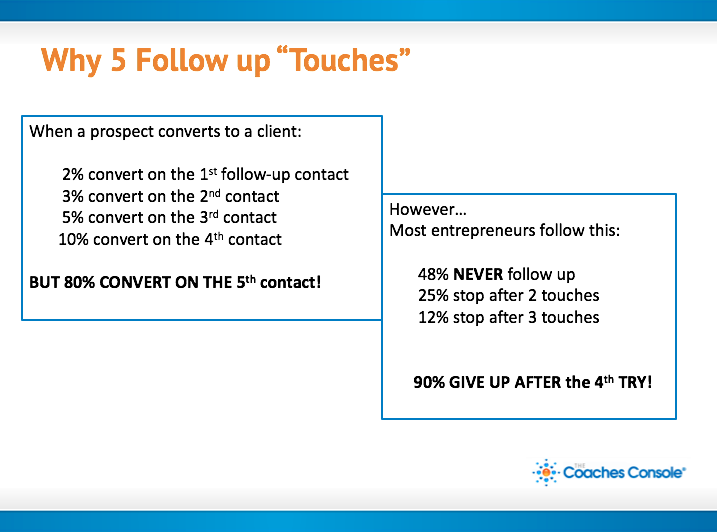
Because we believe the numbers show it best, here’s a graphic we developed to illustrate just how important it is to follow up 5 times after someone downloads your free gift:
Do you see what we see?
Only 2 percent of prospects will convert into clients with a single follow-up contact. That number increases to 10 percent by the fourth contact but jumps to 80 percent by the fifth contact.
That’s right: 80 percent of prospects convert to paying clients after the fifth follow-up contact!
Meanwhile, almost half of entrepreneurs never follow up—not even once. And a whopping 90 percent give up after the fourth follow-up.
Which means that 90 percent of entrepreneurs are leaving money on the table because they’re not converting prospects that very well could become their next paying clients.
Here’s where things really get good: we’ve heard from lots of start-up coaches that they feel “pushy” or “salesy” or “sleazy” when they think about following up multiple times after someone downloads their free gift.
After all, if they’re interested, they’ll call, right? Wrong.
This isn’t personal. It’s not pushy.
It’s a buyer’s pattern. Period.
Our goal with this blog post is to help you shift your mindset: to help you realize that following up multiple times is a necessary part of your sales process. If you want to reach more of the people who need you, it’s key that you follow up 5 times.
You know what’s really SUPER-cool about this? Most likely you’ve already met your next paying client … you just haven’t followed up enough to help them see they’re ready to convert!
Most prospects simply don’t convert to buyers until after you’ve contacted them 5 times, and most entrepreneurs give up far too early, leaving money, opportunities, and potential impact on the table.
Now, you may be wondering what you should say in each of your follow-up emails.
Of course, we have you covered. We’ll talk about that in our next blog post, Your 5-Part Follow-Up Sequence: What to Say to Increase Your Conversions (Part 2 of 2). So stay tuned!
Meanwhile, sign up to receive our complimentary 3-part video training series, “Your Coaching Business Blueprint: Everything You Need To Know To Get Your Business On Track.”
You’ll learn the pattern you may be stuck in, which can sabotage your own efforts to reach your full potential and accomplish your goals, the 3 S’s to your success and why it’s critical to master all 3 (most coaches only master 2), and where your business is leaking money.
Sign up below
Jan 15, 2016
The New Year is in full swing—woohoo!
Along with our best wishes for an efficient, profitable, streamlined 2016, we want to extend what we consider a very important piece of advice … one we’re confident will transform the way you do things and create unimaginable results.
Here we go:
You know how it’s been kind of a trend over the past couple of years for people to begin the New Year by choosing a single word that will serve as kind of a compass over the course of the next 12 months?
You may be nodding your head, thinking of words like: focus, determination, perseverance, planning, organization … and all of these are great!
What if you were to consider a different word, one that may feel a bit foreign at first …
FUN.
That’s right. FUN!
Yes, planning is good. Getting organized in advance is critical. Strategy and execution matter.
At the same time, FUN should be a cornerstone in your business plan. It should be a critical partner to focus.
You know we have a story to illustrate our point. 😉
During our last big promotion, there was one day when certain components of our plan weren’t working exactly as we anticipated. I (Melinda) was in a tizzy.
Yes, the Queen of Efficiency was super-frustrated, and the more I worked on the problem, the messier it got.
I called Kate to dump my charge about the situation, hoping that by clearing out the frustration, I’d be able to focus. Of course, it didn’t work.
I admit, the fun factor was nowhere in my mind in my efforts to sort the situation out, and fast.
The next thing I know, Kate was knocking on my door.
I opened the door, and there she was, smiling, from behind a huge bouquet of flowers. Immediately, a huge smile spread across my face.
Kate came in and led me in a dance break. (Not kidding … we danced around the room like kids!)
Instantly, I began to feel so much better, even though the frustrating situation hadn’t yet changed. I felt lighter and calmer. As we danced, I felt more confident in my capacity to address the non-working components of our plan.
Being on the receiving end of Kate’s kindness—and experiencing the gratitude that came with it—gave me the idea to send all of our promoting partners a bouquet of flowers too, to thank them for helping us realize our vision this year.
Kate and I received Facebook messages, texts, and emails that included pictures of our partners with the flowers. We read stories about the positive impact our special deliveries had on their day. They reported big smiles, along with feeling lighter, happier, calmer and more focused as a result of receiving the flowers.
In the moment when Kate brought me the flowers, something very scientific, physical, and biological happened. Kate’s smile triggered my smile. The dance break (even though, at first, I wasn’t in a fun frame of mind) released a chemical called nitric oxide, which resulted in increased levels of feel-good chemicals like serotonin and beta endorphins.
High levels of nitric oxide, in turn, provided me with increased blood flow to my entire body and internal organs.
Here’s the really cool thing: whereas working harder produces adrenaline that can damage and deplete your body, fun and pleasure fuel you and allow you to tap into creativity in bigger ways, see situations from a new perspective, and develop a greater number of potential solutions!
Again, focus is critical … but it works best when it’s partnered with fun.
Don’t confuse perfectionism with professionalism – you (and your business) don’t need to be “perfect.”
Pay equal attention to focus (strategy, organization, planning, and execution) as you do to fun, and see how it changes your 2016!
Maybe right now you’re wondering HOW, with everything you do in your business, can you add the fun factor?
Think about content creation, client support, creating marketing material, launching promotions, engaging in marketing activities and so on. How can you add in the FUN FACTOR?
I have one more story for you today: I was recently at a JV summit with 112 of our colleagues, and the moderator asked for one piece of wisdom that lead to the level of growth we’ve experienced year after year.
I found myself getting onstage and sharing the story about Kate and the flowers. After I finished speaking, one of the gals in the room—who is already quite successful and is planning to generate 6 figures in her business—approached me to tell me how much she appreciated hearing my story.
She had always operated on the belief that in order to create significant success, you have to simply work hard. She was so grateful to hear my “ray of sunshine” story at that moment. It gave her new hope that she could create the success of which she dreams, in a way that felt natural … in a way that would allow her to enjoy the process, along the way.
I believe you can do the same.
Which is why, as we head full swing into 2016, Kate and I would like to encourage you to focus on FUN, and on everything it can do for your business.
We have a feeling you’re going to like it!
As always, we’d love to hear about how this works out for you, so please feel free to drop us a line on our Facebook page.
Here’s to a Happy and FUN New Year!
